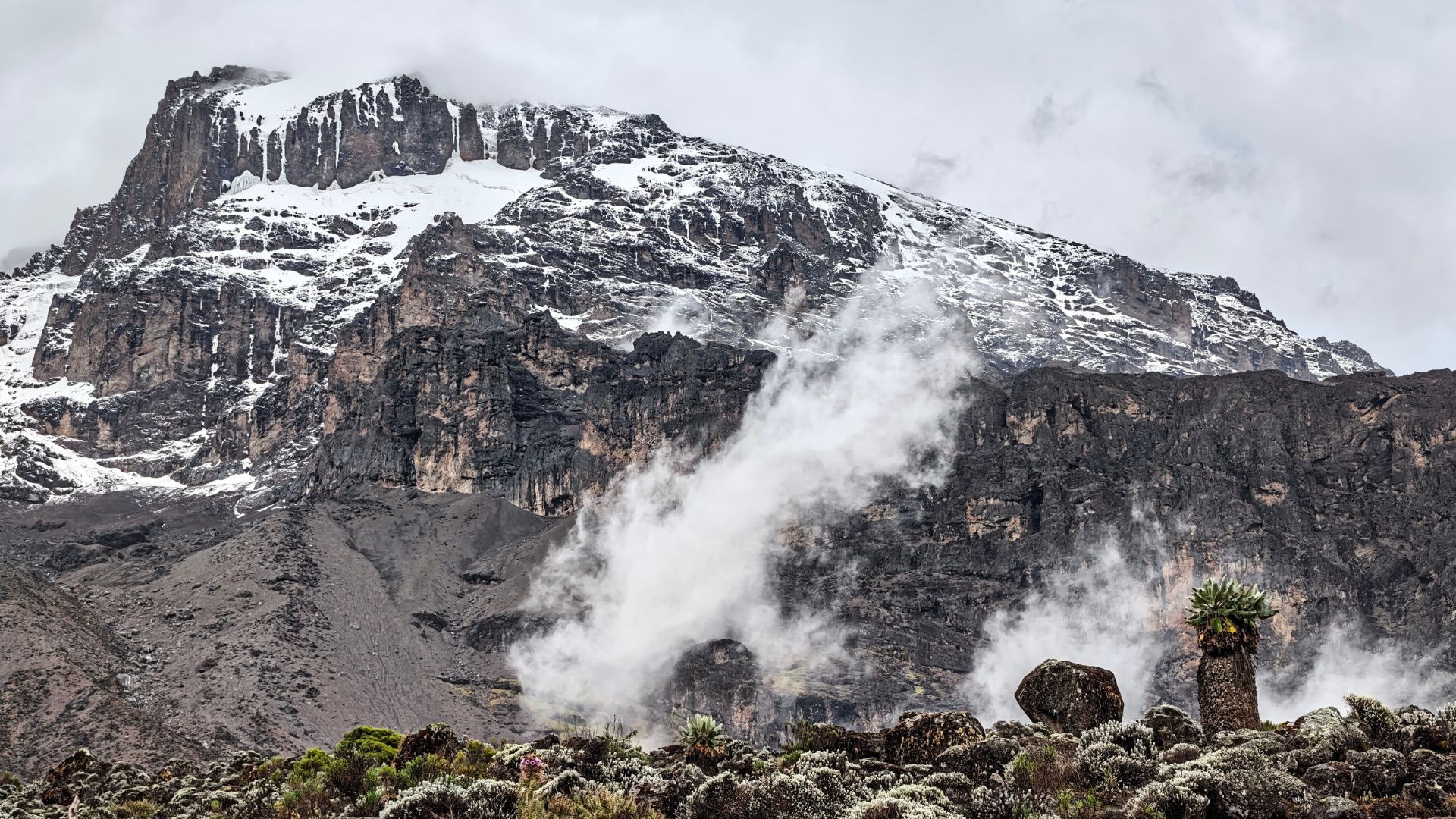
Rising dramatically from the dusty East African plains to a snow-capped summit of 5,895 meters, Mount Kilimanjaro is the highest peak in Africa and the world's tallest free-standing mountain. A stratovolcano composed of three distinct volcanic cones — Kibo, Mawenzi, and Shira — Kilimanjaro is one of the Seven Summits and a UNESCO World Heritage Site.
| Feature | Details |
|---|---|
| Summit | Uhuru Peak, 5,895m (19,341ft) |
| Structure | Three volcanic cones — Shira (3,962m, oldest), Mawenzi (5,149m, dormant), Kibo (5,895m, youngest and highest, still dormant) |
| First Ascent | October 6, 1889 — Hans Meyer, Ludwig Purtscheller, and Chagga guide Yohani Kinyala Lauwo |
| Fastest Ascent & Descent | Karl Egloff (Ecuador/Switzerland) — 6 hours, 42 minutes, 24 seconds, via Umbwe route, 2014 |
| Route | Days | Distance | Success Rate |
|---|---|---|---|
| Lemosho | 7–8 | ~70km | 85–92% |
| Machame | 6–7 | ~62km | 80–88% |
| Northern Circuit | 8–9 | ~90km | 92–95%+ |
| Rongai | 6–7 | ~73km | 75–85% |
| Marangu | 5–6 | ~72km | 50–65% |
| Umbwe | 6 | ~53km | 50–65% |
Begins at Londorossi Gate on the west. Offers high scenic diversity, quiet rainforest sections, and a long profile that maximizes acclimatization.
A highly popular path from the southwest, featuring steep climbs over Barranco Wall and ideal "climb high, sleep low" opportunities.
The longest route, circumnavigating Kibo's northern slopes with virtually no crowds and the highest summit success rate.
The only northern path, approaching from the Kenyan border. A dry microclimate makes it best during rainy seasons.
The only route with wooden sleeping huts, frequently booked as a 5-day climb, which lowers success due to rapid altitude gain.
Steep, short, and direct — suitable only for experienced high-altitude trekkers.
Guideline tips per group, per day: Lead Guide $20–25, Assistant Guide $12–15, Cook $12–15, Porter $6–10 — roughly $300–450 total per climber on a 7-day trek. Choose a KPAP-certified operator (Kilimanjaro Porters Assistance Project) to ensure fair porter wages and humane treatment, and confirm daily pulse oximeter checks, emergency oxygen, and Wilderness First Responder-certified guides.
The main dry windows are January to March (warmer) and June to October (cooler and clearer). Proper pacing ("pole pole") and a 7–8 day itinerary significantly reduce the risk of altitude sickness regardless of season.
Uhuru Peak on Kibo stands at 5,895 meters (19,341 feet) above sea level.
Kibo is dormant and could erupt again in the future, whereas Shira and Mawenzi are completely extinct.
Hans Meyer, Ludwig Purtscheller, and Chagga guide Yohani Kinyala Lauwo, on October 6, 1889.
AMS is caused by rapid ascent to high elevation with lower oxygen density. Symptoms include headaches, nausea, and fatigue. Proper pacing ("pole pole") and a 7–8 day itinerary mitigate the risk.
The Northern Circuit (8–9 days) holds a success rate exceeding 92–95%.
Yes — no technical climbing skills or ropes are needed. Good endurance fitness and strong mental resolve are required.
Plan for approximately $300 to $450 USD total per climber in pooled tips for a 7-day trek.
Tell us your travel dates and what you're hoping to see, and we'll recommend the right route into it.